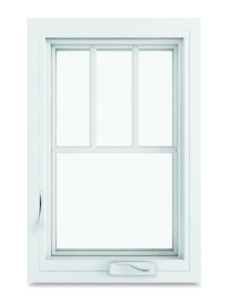
Picking out new windows involves more decisions than most homeowners expect. Frame material, glass package, grille pattern, color. Then your dealer asks which way you want the casement windows to swing, and it catches you off guard.
It is a fair question, and the answer affects how the window works every day.
Here is the short version. Casement windows should swing outward in almost every application. That means the screen sits on the interior side of the frame. From there, you choose whether the hinges go on the left or the right.
This guide walks through both decisions so you can talk through your options with confidence.
A casement window pivots on side hinges instead of sliding up or down. A crank handle does the work, which is why casements are the go-to choice above a kitchen sink or anywhere else you cannot comfortably reach the sash.
Swinging outward brings several practical advantages:
Inward-swinging casement windows do exist. They are more common in Europe, and they make sense in some situations such as upper floors where exterior access is difficult.
Handing is the industry term for the side on which a window is hinged. There is one rule that trips people up, so it is worth stating plainly.
Handing is always determined by looking at the window from outside your home.
Manufacturers label casements two ways:
FCL means a left-hand casement. The hinges are on the left, and the lock is on the right when viewed from the exterior.
FCR means a right-hand casement. The hinges are on the right, and the lock is on the left, again from the exterior.
On a shop drawing or window schedule, you will see a dashed triangle drawn across the sash. The point of that triangle marks the hinged side. A point to the left means FCL. A point to the right means FCR.
Get the reference point backward, and you end up with a window that opens the wrong way. It is one of the more common ordering mistakes, and it is not a cheap one to correct.
There is no universal right answer. Both configurations are readily available, so the choice comes down to how the room works.
Use these guidelines to land on the right decision:
Casements work well in kitchens, bathrooms, stairwells, and any spot where reach is limited. They also pair well with awning windows in the same opening.
With casement windows the sash presses into a compression seal when closed.,This makes them perform very well in air infiltration testing, which helps comfort and energy bills. Check the NFRC label on any unit you consider and compare U-factor and air leakage ratings across products. The Department of Energy and ENERGY STAR both have plain-language guidance worth reading before you shop.
Still narrowing down styles? Our overview of window types compares your options side by side, and our free window-buying checklist covers what to ask before you sign anything.
Can I change the hinge side after installation?
Not practically. Handing is built into the frame and sash at the factory. Decide before you order.
Do casement windows work with window treatments?
Yes, and better than you might expect. Since the sash swings out, blinds and shades can be mounted normally without interference.
Are casement windows a good choice for older houses?
Yes, many historic properties in our region originally had casement windows. Quality Window & Door offers historic window options that satisfy review boards while performing like modern units.
Handing decisions get much easier when you can stand in front of an operating window and turn the crank yourself.
Quality Window & Door has served homeowners throughout DC, Maryland, and Virginia since 1989. Visit our Beltsville or Fairfax showrooms to compare casement windows from the brands we carry, or check our service area to confirm we cover your neighborhood.
Request a free consultation or call 1-800-370-8751. We will measure your openings, confirm the handing, and make sure every window operates as you expect.
Here's a look at our door installation process!
See our Maryland door installation experts in action with this timelapse video of a recent project!




















 Tell us
about your project
Tell us
about your project