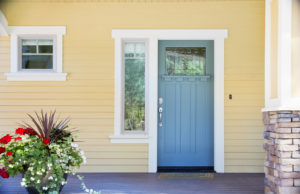
You picked the style, you settled on a finish, and are now ready to order a new door.
Then your dealer asks whether you want a right-handed door or a left-handed door, and the whole thing stalls.
It is a simple question with an annoying amount of room for error. Order the wrong handing and the door arrives with the hinges on the wrong side. Custom doors are rarely returnable, and the wait starts over.
Here is how handing works, how to check yours in about ten seconds, and how to decide which way your new door should swing.
Handing describes two things at once. Which side the hinges are on, and which way the door swings.
Both matter. A door with hinges on the right that opens into your living room behaves nothing like a door with hinges on the right that opens onto your porch.
The confusion comes from the reference point. Handing only makes sense if everyone is standing in the same place when they describe it.
For exterior doors, that place is outside your home. The industry calls this the secure side or the key side. It is the side where the lock cylinder lives.
Walk outside and stand facing your door.
Look at the hinges. Are they on your left or your right? That is half the answer.
Now open the door. Does it swing away from you into the house, or does it come toward you?
Put the two together:
Reverse simply means the door opens outward. Most entry doors in this region are inswing, so RH and LH cover the majority of homes. Outswing doors show up more often on porches, mudrooms, and storm-exposed elevations.
Not every manufacturer defines handing the same way. Some hardware suppliers use a different reference point entirely. The Archtoolbox door handing guide lays out the standard chart clearly if you want a visual. When in doubt, take a photo of your existing door from outside and bring it with you.
If you are replacing an existing door, matching the current handing is usually the path of least resistance. The framing, the flooring transition, and the traffic pattern all already work, but here are a few other things to consider:
For patio openings, handing works a little differently. Sliding and multi-panel systems use active and fixed panels instead of hinges. Our recent comparison of French doors and sliding doors covers how each option affects your layout.
Sometimes, yes. Swapping a swing means relocating the hinge mortises and the strike plate on the jamb, then flipping the hardware on the slab.
On a simple interior door with a reversible lockset, an experienced carpenter can manage it. On an exterior door, it gets complicated fast. The weatherstripping, the sill, the threshold, and the sweep are all built for one direction. Reversing them often leaves you with a door that no longer seals properly.
If the existing door is old or already underperforming, ordering a new one with the correct handing is usually the better investment. Our guide to door replacement walks you through the process.
Handing is one of those things that clicks immediately once you stand in front of a real door and open it.
Quality Window & Door has helped homeowners across DC, Maryland, and Virginia choose doors since 1989. Visit our Beltsville or Fairfax showrooms to compare entry doors and patio doors from the brands we carry. Browse our photo gallery for ideas, or check our service area to confirm we cover your neighborhood.
Request a free consultation or call 1-800-370-8751. We will measure the opening, confirm the handing, and make sure what arrives is exactly what you expected.
“They were able to find the right window for our home and our needs”
When it comes to the Quality Window & Door experience, sometimes it’s best to let our happy customers do the talking.




 Get a FREE Consultation
 Call Us at 1-800-370-8751



















 Tell us
about your project
Tell us
about your project